
What is VOC testing?
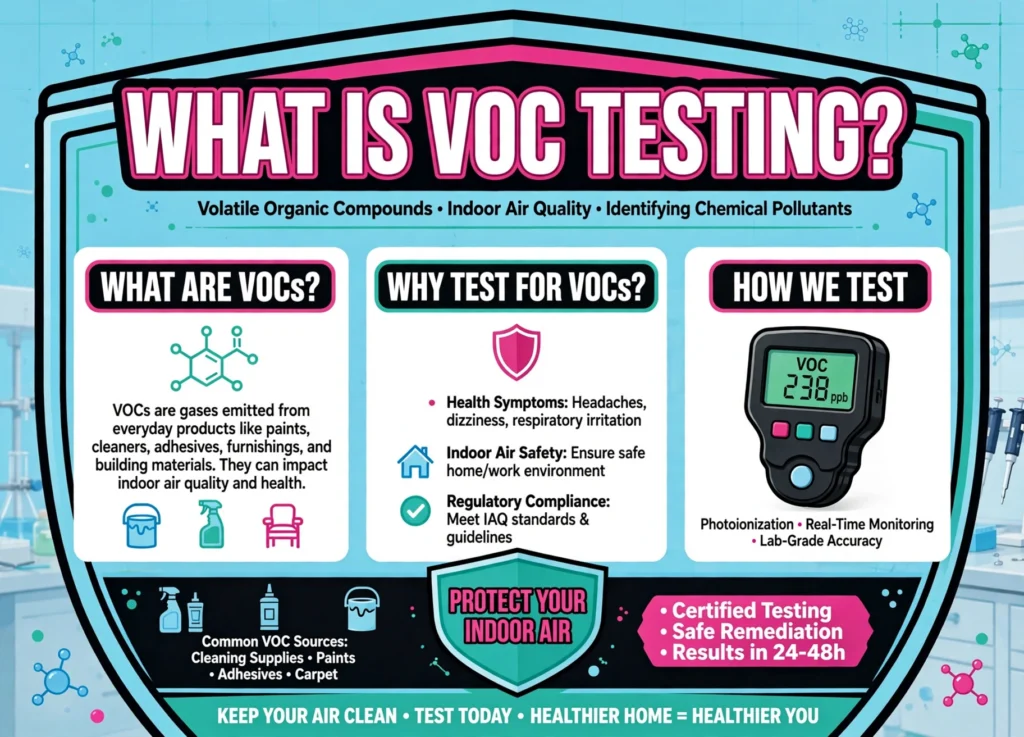
Kitchen household products, building materials, chemicals, and furnishings release some gases which are called volatile organic compounds. Volatile organic compounds are also called VOCs. VOC testing is a term used for the process of evaluating indoor air quality testing to identify the presence of volatile organic compounds. This testing helps determine if these chemical compounds are causing air-quality concerns.
VOC testing services are provided for hotels, offices, apartments, homes, condos, schools, and commercial buildings. The testing may be necessary if there is a constant musty odor, water damage, recent renovations, smoke exposure, or poor indoor air quality.
Miami Mold Services is a reliable source for providing VOC testing in Miami for everyone who wants to identify odor sources and existing contamination in air.
What are VOCs?
Chemicals that convert to gases at room temperature and absorbed by indoor air are called VOCs. Some of these gases have a very strong odor while others may not emit any odor. These chemicals are produced from:
- New flooring, furniture, cabinets, or carpets
- Smoke and fire residue
- Varnishes, paint, stains, and primers
- Solvents and pesticides
- Caulk, sealants, glue, and adhesives
- Candles, fragrances, aerosol sprays, and air fresheners
- Disinfectants and cleaning products
- Moisture-damaged materials
- Building materials and insulation
- Fuel, gasoline, and stored chemicals
- Poor ventilation and HVAC
VOC types and amounts can differ according to the renovations, humidity, cleaning, temperature, and ventilation.
Importance of VOC testing
If you feel a constant smell that feels like paint, chemical, smoke, sweet, or unexplained source, it is a sign that VOCs are present in the air. To identify the source of these odors, VOC testing is recommended. It is also essential if a property has experienced remodeling, painting, fire damage, water damage, or poor indoor air quality.
Miami has a humid and warm climate that increases the release of these gases that affect the indoor air quality. These odors may also be caused by HVAC issues, moisture, poor ventilation, and other sources. VOC testing is used to investigate:
- Smoke or fire odors
- Poor indoor air quality
- Odors from HVAC
- Odors from renovations
- Inexplicable indoor odors
- Chemical exposure concerns
- Water-damage concerns
- Mold or mildew suspects
- Indoor air concerns of commercial and residential properties
What is measured by the VOC test?
VOC testing is performed to identify special compounds in the air or measure the amounts of VOCs. Purpose of testing and the level of information may determine the method of testing. A few testing methods only provide general information about VOCs levels, while further testing may be performed to get comprehensive information about the compound found in the sample.
VOC reports must be considered along with professional visual analysis for better understanding. Moisture conditions, recent water damage or renovations, history, or ventilation must be evaluated properly. Visual analysis will help identify the exact source, condition of the property, and health effects of VOCs.
VOC testing process step-by-step
History and odor assessment
Assessment of the property is very important to start the process. The assessor will ask about what is the main area of odor, when the odor started, and history of any water or fire damage. He will also enquire about HVAC issues, recent renovations, cleaning products, or other unexplained issues.
Visual evaluation
Visual evaluation is performed to identify the sources such as mold, damaged materials, water stains, smoke residue, chemical storage, poor ventilation, or other causes. If water damage or moldy odors are found, moisture measurement is also essential. VOC is helpful to identify the quality of indoor air but it cannot detect or correct the source of moisture.
Air sampling
According to the conditions, indoor air screening may be performed or air sampling may be done for lab testing. If required, outdoor air sampling is also collected for further information.
Test reports
After the results are documented, recommendations for further steps are made. Recommendations may include:
- Cleanup of smoke residue
- Moisture source correction
- Maintain proper ventilation
- Replacement of damaged goods
- Elimination of odor source
- Leak repair
- Further inspection from a professional
- Connection between mold and VOC testing
It is often misunderstood that mold and VOC testing are the same. However, these are two different procedures. Mold releases microbial volatile organic compounds that are also called MVOCs and can cause musty odor. VOC testing is not helpful to determine the presence of mold or source detection. Mold inspection and detection is very important alongside VOC testing if mold, moisture, or musty odors are identified.
VOC testing for smoke or fire damage
If a property experiences fire damage, smoke odors and particles stuck inside flooring, HVAC, cabinets, drywall, furniture, insulation, and other materials. These materials may release compounds that cause constant odors. VOC testing can identify the quality of indoor air after a fire damage. However, removal of highly affected materials, smoke odor removal, soot cleaning, and water damage correction is also essential for proper restoration.
What are the signs that require VOC testing?
VOC is required when:
- Chemical or other odors are constant
- Odors return even after cleaning
- Constant smoke odor after a fire damage
- Odors are present while HVAC system is running
- Odors coming after remodeling or painting
- Indoor air quality is concerning
- Occupants experience respiratory difficulties
What is included in VOC testing?
VOC testing has its significant benefits, yet it cannot identify the source. Testing results may also be affected by air fresheners, weather, humidity, temperature, ventilation, cleaning chemicals, and open windows. VOC cannot be a replacement of:
- Carbon monoxide testing
- Mold inspection or testing
- Moisture detection
- Natural gas leak detection
- Plumbing leaks
- Fire damage restoration
- Medical evaluation
If you notice any of these signs in your property, contact a relevant service provider or call an emergency service.
How to prevent VOCs?
VOCs may be reduced if you:
- Use of bathroom and kitchen exhaust fans
- Repair water leaks quickly
- Dry out wet materials
- Maintain HVAC systems
- Keep proper ventilation according to weather
- Keep chemicals, solvents, strong cleaning products, and finishes safely stored
- Dry out the area properly after new paint, renovation, or furniture
- Correct the source of mildew, mold, smoke residue, and remove damaged goods
FAQs
Can VOCs cause a musty odor?
VOCs are a source of musty odors, but musty smell can also be sourced by mildew, mold, poor ventilation, water damage, or HVAC issues.
Are VOC testing and Air-quality testing the same?
VOC testing is a type of indoor air quality testing. Air quality testing also involves mold concerns, smoke residue assessment, humidity, ventilation, and other environmental assessments.
Are VOCs produced by new paint or flooring?
Yes, new building materials such as paint, flooring, sealants, adhesives, and cabinets may cause VOCs.
Can VOC testing detect mold?
No, VOC testing is not able to identify mold source or mold development.
Call us for VOC testing services
We offer VOC testing for properties experiencing water damage, smoke, poor indoor air quality, or a persistent musty smell. Call us and book an appointment for your property assessment and sample collection.

Michael Anthony
Author Profile: Owner & Certified Mold Remediation Specialist
Michael Anthony is a certified mold inspector, assessor, and remediator serving Miami and all nearby areas. He has years of hands-on experience in mold damage restoration across residential and commercial properties. His work helps homeowners and businesses throughout the region protect their properties from mold damage and maintain healthier indoor environments.
- (305) 401-3606